Misconception first: many traders treat an exchange account, a Web3 wallet, and spot trading as interchangeable pieces of the same puzzle. They are not. Confusing custody, access methods, and trade execution creates real risk—lost seed phrases, phishing losses, or unexpected slippage during volatile spot moves. This article unpacks how OKX stitches these components together, compares custody versus self-custody trade-offs, and gives US-based traders a repeatable mental model to decide where to place assets for spot trading, staking, or longer-term storage.
I’ll start with the mechanisms—how accounts, wallets, and spot markets work on OKX—then contrast centralized custody (the exchange account) with the non-custodial Web3 wallet. Along the way I’ll highlight limits, costs, and the operational controls that matter when you log in, fund, or move assets. If you want to jump straight to logging in, here’s a practical link to an OKX entry point: okx login.
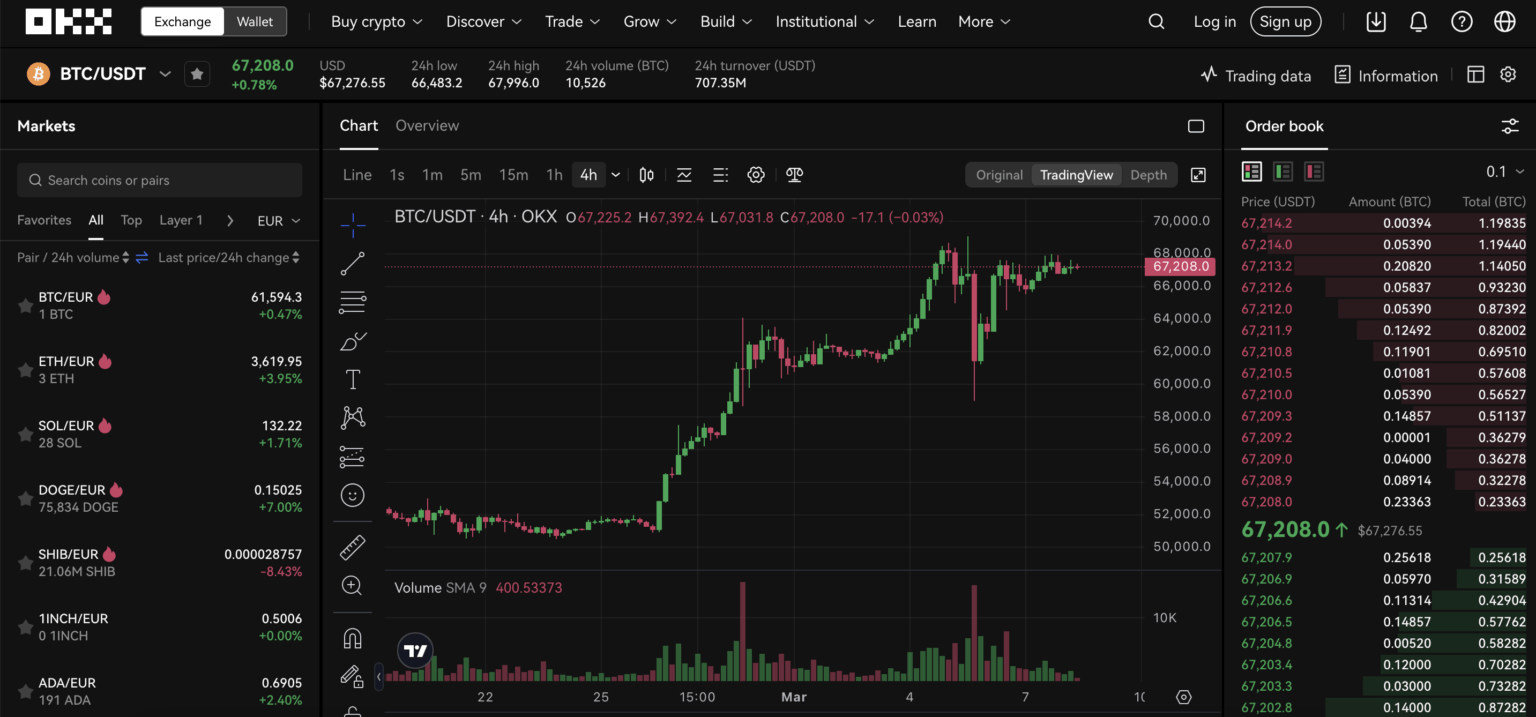
How OKX assembles the technical layers: account, custody, and spot execution
At base, OKX offers a centralized exchange (CEX) account and a separate self-custodial Web3 wallet. The CEX account is where you log in, complete KYC (required for US-facing services), and trade spot or margin products. Mechanically, when you place a spot order on the exchange, you’re instructing OKX’s matching engine to exchange ownership of ledger entries on its internal database—this is centralized custody until you withdraw to an external address.
The Web3 wallet option flips custody: you hold the private keys locally (seed phrase, hardware wallet integration), and any swap or DeFi interaction occurs from that wallet. OKX’s DEX aggregator can route swaps across on-chain pools to find efficient routes, but those trades execute on-chain and expose you to smart contract and gas risks. Understanding whether an action updates a centralized ledger (fast, cheap, custodial) or an on-chain state (slower, transparent, self-custodial) is the single most useful distinction for operational risk management.
Spot trading on OKX: execution, fees, and risk vectors
Spot trading on OKX uses the exchange’s central order book and TradingView-style charts. Execution speed is high and fees are typically lower than on-chain swaps for equivalent liquidity, but there are trade-offs: slippage, order-book depth, and delistings. For instance, recent delistings of several low-liquidity pairs are an explicit reminder: exchanges prune poorly traded or risky assets to keep markets healthy. That protects overall liquidity but can strand positions in niche tokens if you don’t monitor announcements.
For US traders, practical considerations include mandatory KYC (ID and liveness checks) and account security measures—military-grade encryption, AI-driven login monitoring, and mandatory 2FA (SMS, authenticator apps, or biometrics on mobile). These controls reduce account-takeover risk, but they don’t eliminate phishing or social-engineering attacks that target credentials or 2FA codes. The operational takeaway: treat your exchange login like a high-value asset—use unique passwords, hardware security keys where supported, and never respond to unexpected login prompts.
Custody trade-offs: exchange account vs. self-custodial wallet
Choice 1 — Keep funds on OKX (custodial): advantages are convenience, fast spot execution, access to staking and DeFi yield products within the platform, and reduced friction for trading derivatives or margin. OKX stores over 95% of assets in multi-signature cold wallets—this minimizes hot-wallet exposure. The platform also offers Proof of Reserves (PoR), an on-chain transparency measure that helps you verify backing. But custodial storage means counterparty risk: if the exchange were to face insolvency (an unlikely but non-zero systemic risk), your operational control over assets is lower.
Choice 2 — Use OKX’s non-custodial Web3 wallet or external hardware wallets: the upside is true self-custody and full control over private keys, which prevents exchange-side freezes and reduces counterparty dependence. Integration with Ledger and Trezor makes this more viable. Downsides: you inherit responsibility for seed phrase security (permanent loss if misplaced), exposure to smart contract exploits when interacting with DeFi, and slower on-chain settlement with gas costs. For traders, a hybrid approach—active trading funds on the exchange, larger long-term holdings in self-custody—is usually the best practical compromise.
Staking and yield: passive income with structural caveats
OKX offers flexible and fixed-term staking along with DeFi yield farming and auto-compounding. Mechanically, staking locks or delegates assets to protocols or validators to earn rewards; OKX may manage the validator side for you in custodial staking. The allure of higher yields must be balanced against lock-up periods, validator slashing risk, and counterparty risk in a custodial setup. If you opt for on-exchange staking, verify the unstaking window and whether rewards compound automatically—these details materially affect realized APY and liquidity management.
Decision heuristic: if you need intraday liquidity, avoid long lock-up staking on the exchange; if you can tolerate multi-week lock-ups and want ease, custodial staking can be a reasonable option. Always check whether on-chain staking would yield materially different reward structures compared with exchange-managed staking—sometimes yields differ because of platform fees or operational efficiency.
Mechanism-level limits and common failure modes
Three failure modes deserve attention. First, phishing: attackers mimic login flows and trick users into revealing 2FA codes or seed phrases. Second, operational delistings: exchanges periodically delist low-volume tokens (recently several spot pairs were removed), which can force conversions or impose withdrawal windows. Third, smart contract risk when bridging or using the DEX aggregator: on-chain bridges and pools can be exploited. All are avoidable or mitigatable with concrete habits: verify withdrawal addresses, maintain separate accounts for trading and long-term storage, and limit on-chain approvals with wallet tools.
Note on proof and transparency: OKX’s PoR helps with backing confidence but does not eliminate operational risks like phishing or user-side key loss. PoR confirms aggregate backing; it doesn’t restore lost private keys or prevent smart contract bugs. Distinguish between solvency transparency and user operational security.
Practical framework: how to allocate assets between trading, staking, and cold storage
Use a three-bucket rule based on time horizon and required liquidity. Bucket A — Active trading: 5–20% of your crypto portfolio, kept on-exchange with 2FA and session protections to execute spot trades quickly. Bucket B — Yield and medium-term exposure: 10–30% split between exchange staking (for convenience) and on-chain staking (for control), matched to the liquidity you can tolerate. Bucket C — Long-term cold storage: remaining assets in hardware wallets or non-custodial OKX wallet with seed phrases offline. Rebalance buckets when market conditions, personal risk tolerance, or regulatory constraints change.
This heuristic is a decision-useful starting point, not investment advice. The precise percentages should be adjusted for individual risk profiles and tax considerations; US traders must also factor KYC data, tax reporting, and potential regulatory changes into allocation decisions.
What to watch next (near-term signals and conditional scenarios)
Monitor three signals: exchange delisting patterns (which indicate tightening of listed assets and liquidity curation), changes to KYC or access for US users, and shifts in yield product terms (lock-up windows, APY). If OKX or other exchanges accelerate delistings, expect more on-chain migration of niche tokens to DEXes—which raises on-chain risk. Conversely, stronger PoR transparency and cold storage practices can increase institutional confidence in CEX custody. These are conditional scenarios tied to governance choices and market incentives.
FAQ
Q: Should I always withdraw to a hardware wallet after buying on OKX?
A: Not always. If you trade frequently, keeping a portion on OKX reduces friction and slippage. For long-term holdings, hardware wallets reduce counterparty risk. The right balance depends on your trading frequency and tolerance for custody risk—use the three-bucket rule above as a heuristic.
Q: Does OKX’s Proof of Reserves mean my funds are completely safe?
A: PoR improves transparency about aggregate backing, which is valuable. It does not protect you from phishing, lost private keys, or smart contract exploits. Treat PoR as one trust signal among several, not a complete safety guarantee.
Q: Can I use the OKX Web3 wallet and the exchange account interchangeably?
A: Mechanically they are distinct. The Web3 wallet is self-custodial and signs on-chain transactions; the exchange account is custodial and uses internal ledger entries. You can move funds between them, but each move incurs different costs and risks—on-chain transfers have gas and bridge risks, while exchange withdrawals depend on platform withdrawal controls.
Q: How do delistings affect spot traders?
A: Delistings typically affect low-liquidity pairs and can force conversions or withdrawals before a deadline. Traders holding small-cap tokens should watch the exchange’s announcement channel and be prepared to convert or withdraw to retain control.
To conclude: treat OKX as an integrated platform that offers both custodial convenience and self-custodial options. The right choice depends on your time horizon, operational discipline, and tolerance for counterparty risk. Focus on mechanisms—where the custody actually resides, how trades settle, and what protections exist—so your decisions about logging in, moving funds, or staking are defensible and repeatable.
